Brock Owens and Ashley J. Pitts open the settlement's first store near the Alapaha River. The community, known as Kings' Crossing, establishes its post office on November 1, 1888, with Pitts as the first postmaster. A town is born.
Where the Railroad Met the River
A jewel of Wilcox County — rooted in the land, shaped by the rails, and still telling its story after more than a century.
31.9453° N · 83.5400° W · Elevation 381 ft
Scroll
Long before it bore its current name, the settlement that would become Pitts was known as Kings' Crossing — a small community nestled two miles east of the Alapaha River in south-central Georgia. The land was part of the vast Coastal Plain, flat and fertile, where longleaf pines towered over fields of cotton and peanuts.
In the mid-1880s, two men — Brock Owens and Ashley J. Pitts — opened the first store in the settlement, marking the beginning of commerce in what had been purely farmland. When the community applied for a post office, J.A. King suggested they name the town after his son-in-law, Ashley Pitts, since "Kings' Crossing" was deemed too long for postal purposes.
On November 1, 1888, the post office was established with Ashley J. Pitts as the first postmaster. The town was formally incorporated by the Georgia General Assembly in 1905, coinciding with the arrival of the railroad that would transform this quiet crossroads into the rail center of western Wilcox County.
Kings' Crossing
Renamed because it was too long for the post office
November 1, 1888
Ashley J. Pitts served as the first postmaster
1905
By the Georgia General Assembly, timed with the railroad's arrival
Wilcox County
Founded 1857 — county seat is Abbeville
From frontier settlement to modern-day artisan farmland, each decade shaped the character of this enduring small town.
Brock Owens and Ashley J. Pitts open the settlement's first store near the Alapaha River. The community, known as Kings' Crossing, establishes its post office on November 1, 1888, with Pitts as the first postmaster. A town is born.
The Hawkinsville and Florida Southern Railway, founded in 1896, extends through western Wilcox County, making Pitts the main rail center of the region. The town is incorporated in 1905. White-oak barrel staves are produced locally and shipped overseas for whiskey barrel production. Commerce thrives.
Pop. 1910: 279The railroad connects Pitts to Hawkinsville and points south, driving economic growth. Agriculture flourishes with cotton and peanuts as primary crops. The town grows steadily as the rail line brings both goods and new residents to the area.
Pop. 1920: 352On April 20, 1921, a fireball streaks across the Georgia sky and explodes above Pitts, scattering four iron meteorite fragments across a mile-wide field. The largest piece, weighing 8.3 pounds, would eventually find its way to the Smithsonian Institution — putting Pitts on the map in a way no one could have predicted.
Through the Great Depression and World War II, Pitts endures. Families hold fast to the land and to each other. Agriculture — cotton, peanuts, and timber — remains the economic backbone. The strength of community carries the town through uncertain times.
Pop. 1940: 371Pitts' 8th Street hums with activity. Nearly 400 residents support a vibrant downtown: the Pitts Movie Theater shows the latest pictures, Owens & Pitts General Store (the town's original merchant) continues to serve families, Shell's Bonded Warehouse handles the harvest, and King's Garage keeps the town's trucks and tractors running. Saturday mornings bring farmers into town for supplies and conversation.
The winds of change reshape the rural South. E.B. Jett converts the old movie theater into Jett's Hardware, and new patterns of life emerge. Farming evolves with mechanization, and the character of small-town Georgia begins a quiet transformation — but the heart of the community remains.
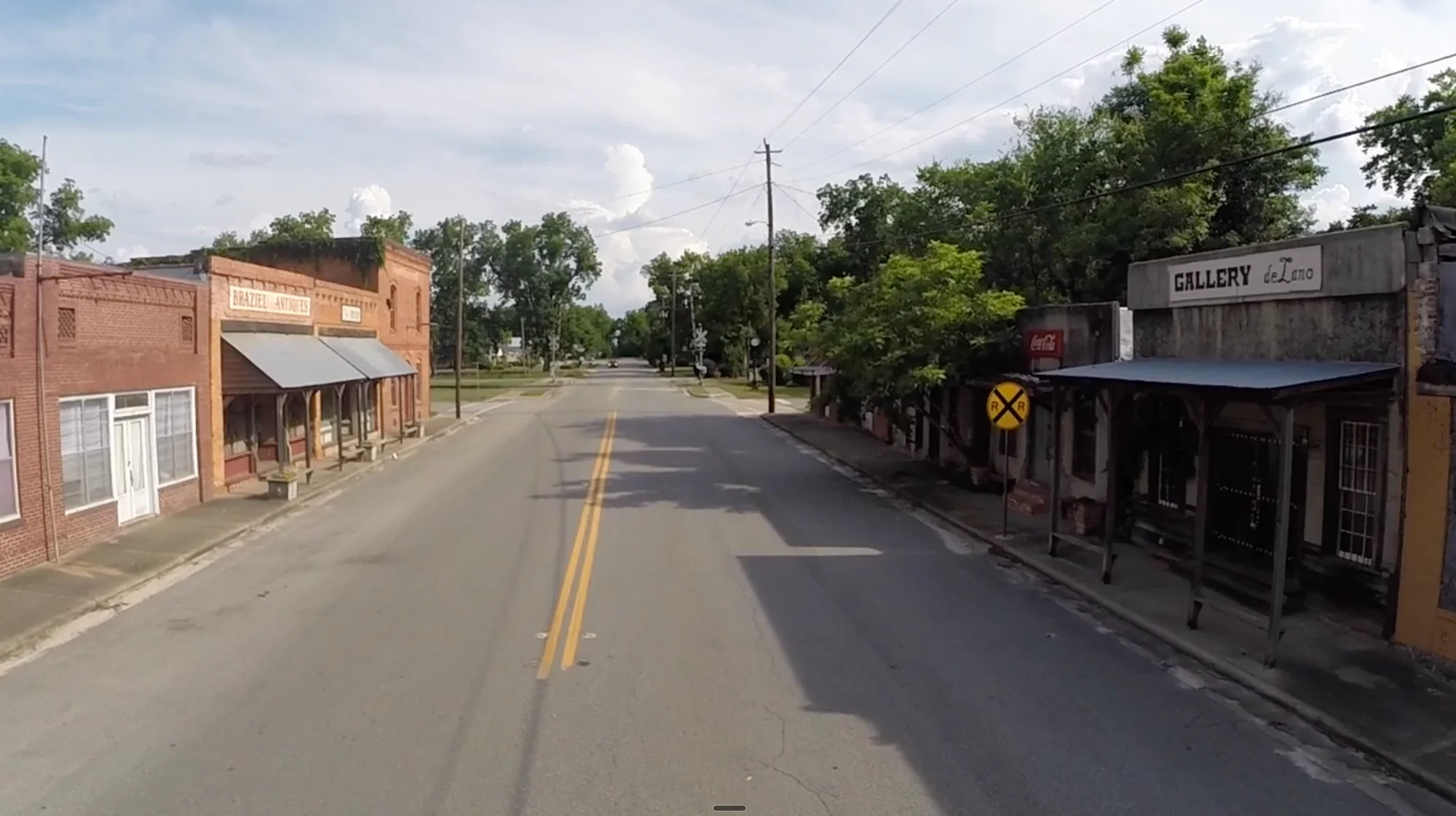
Local preservationist Delano Braziel works to restore historic storefronts on 8th Street, honoring the town's architectural heritage. Oliver Farm emerges as a nationally recognized artisan food producer, earning Good Food Awards and features in The New York Times. The old King's Garage is reborn as The Station, and sunflower fields paint the landscape gold each summer.
A fireball visible from a thousand miles away. An explosion heard across the region. Four fragments of iron from deep space, scattered across the Georgia countryside.
On the morning of April 20, 1921, observers across the southeastern United States witnessed a brilliant fireball streaking across the sky. The meteor's trail culminated in a series of explosions directly above the town of Pitts, Georgia.
Four iron fragments rained down across an impact area approximately one mile long and half a mile wide north of town. One fragment reportedly fell dangerously close to a child playing outdoors. The largest piece, weighing 3.76 kilograms (about 8.3 pounds), was recovered and eventually sent to Washington, D.C.
Classified as an IAB iron meteorite with unusual silicate inclusions, the Pitts Meteorite is scientifically notable for blurring the line between iron meteorites and stony-irons. The largest fragment now resides in the collection of the Smithsonian Institution.
What makes Pitts special isn't its size — it's the spirit of a community that has held together for over 130 years. Here's what defines this Georgia jewel.
Over 130 years of continuous community, from frontier crossroads to modern artisan destination.
Oliver Farm has been in the same family for over a century — a Georgia Centennial Farm with national awards.
Wilcox County is the second-largest watermelon producer in all of Georgia — sweetness from the soil.
A piece of Pitts sits in the Smithsonian — the 1921 meteorite that fell from the stars.
Storefronts lovingly preserved and restored, keeping the architectural character of old Georgia alive.
Oliver Farm's seasonal sunflower fields paint the landscape in gold, drawing visitors from across the state.
Just two miles away, the Alapaha River vanishes underground — one of Georgia's most unusual natural wonders.
Featured in The New York Times and Garden & Gun — the world is discovering what locals always knew.
The buildings and places that tell the story of Pitts — some beautifully restored, some weathered by time, all part of the fabric of this Southern town.
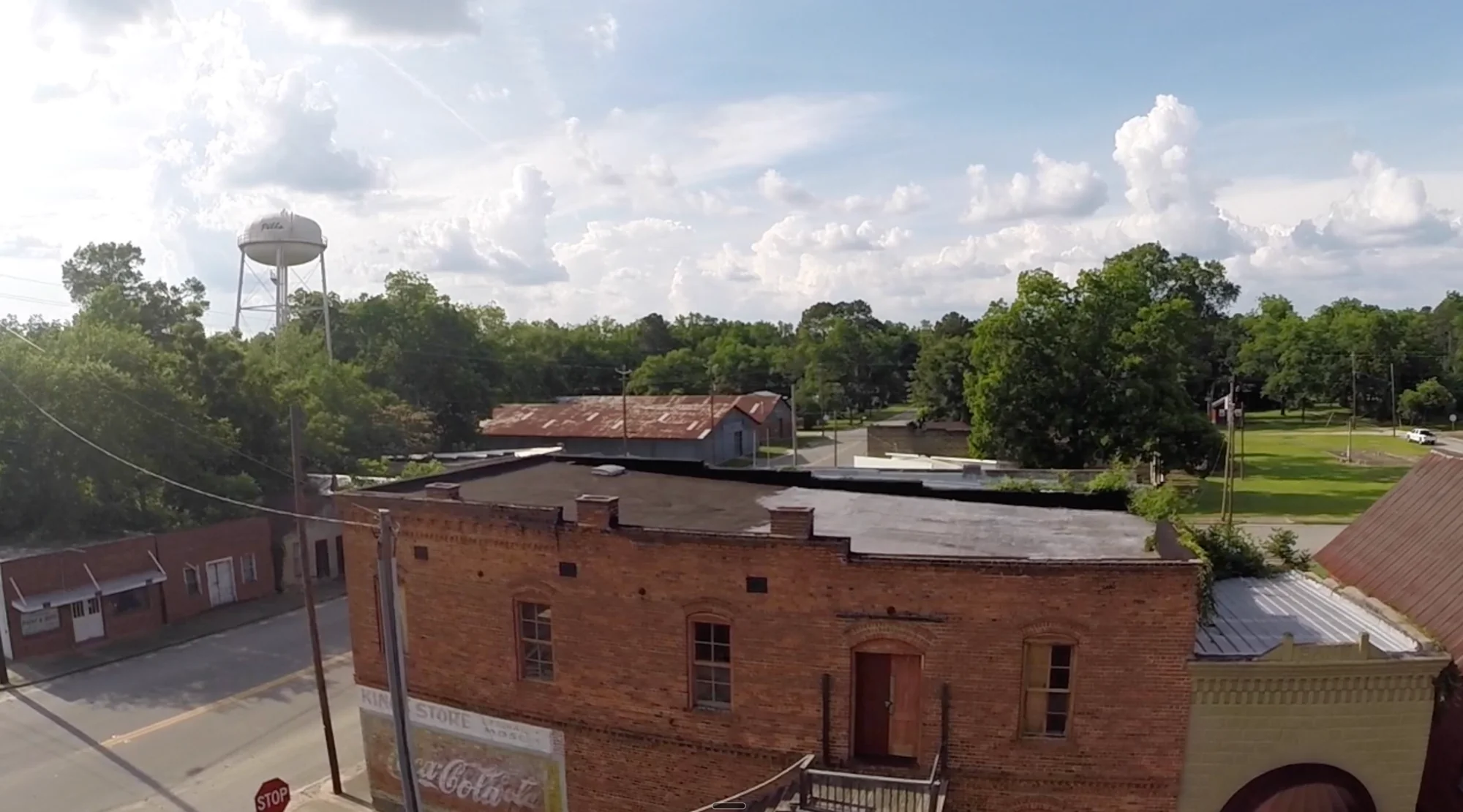
The heart of Pitts' commercial life for over a century. Multiple storefronts have been restored and stabilized by local preservationist Delano Braziel, maintaining the town's architectural character.
A Victorian-era residence built by Robert King's father, home to three generations of the King family until 1992. A landmark connecting Pitts to its founding family.
An agricultural storage facility that served the farming economy for decades. A reminder of the warehousing infrastructure that once supported cotton, peanut, and timber trade.
Features period landscaping with ornamental palms and lantana typical of early 20th-century south Georgia yards. A living snapshot of how Pitts' families tended their homes.
A historic congregation that has anchored the spiritual life of Pitts for generations. Primitive Baptist churches are a hallmark of rural south Georgia heritage.
The old King's Garage, salvaged after its roof collapsed in 2016 and converted into Oliver Farm's retail storefront. Award-winning artisan oils and seasonal sunflower fields draw visitors from across the state.
A Georgia Centennial Farm — the same family, the same land, for over 100 years — putting tiny Pitts on the national culinary map.
In an era when small-town agriculture often means commodity crops and slim margins, Clay Oliver charted a different course. Growing up on his family's multi-generational farm in Pitts, he saw potential in the land that others might have overlooked.
Oliver Farm produces cold-pressed artisan oils — pecan, peanut, sunflower, sesame, benne, and pumpkin — along with gluten-free flours. Their products have earned national recognition, including features in The New York Times and Garden & Gun Magazine.
The farm's retail storefront, The Station, occupies a historic building on 8th Street — the old King's Garage, salvaged after its roof collapsed in 2016 and lovingly restored. In summer, the farm's sunflower fields paint the landscape in gold, drawing visitors to a town that many had never heard of.
As a designated Georgia Centennial Farm, Oliver Farm represents not just agricultural excellence, but continuity — proof that the land Pitts was built on still has stories to tell.
Pecan Oil — National recognition for artisan quality
Garden & Gun Magazine
Green Peanut Oil
Same family, same land, for over a century
National press for a town with a whole lot of heart
Pitts sits in the Georgia Coastal Plain, a landscape of flat farmland, longleaf pines, and slow-moving rivers. The town occupies just 0.80 square miles in the western part of Wilcox County, approximately two miles east of the Alapaha River.
The Alapaha is a remarkable waterway — a 202-mile river that is intermittent for part of its course. During low-flow periods, the river actually disappears underground, becoming a subterranean river before eventually feeding into Florida's Suwannee River system.
The climate is warm and subtropical, with hot, humid summers and mild winters. A long growing season of 283 days makes the land ideal for peanuts, cotton, watermelons, and the specialty oil crops that Oliver Farm has made famous.